

In short: In the first weeks, breastfeed your newborn at the first signs of hunger, day and night – usually at least 8 to 12 times in 24 hours. A good latch is key: wide-open mouth, chin touching the breast and no pain throughout the feed. Wet and dirty nappies (from day 5–6 at least 5–6 heavy wet nappies a day) and steady weight gain show your baby is getting enough milk.
Author: Eva Birsa, mum and co-founder of Evitas · Updated: 26 October 2026
The first hour and colostrum
WHO and UNICEF recommend starting breastfeeding within the first hour after birth, and the NHS advises skin-to-skin contact straight after birth – babies are usually alert then and have a strong rooting reflex. If the first feed isn't possible (for example after a caesarean or if your baby needs care), start as soon as you can; La Leche League stresses it is never too late for skin-to-skin.
Your first milk is colostrum: thick, yellowish and small in volume – according to the NHS, your baby needs only about a teaspoon per feed in the first days. That is why frequent feeds are normal. Your milk usually “comes in” 2 to 4 days after birth, when your breasts feel fuller and heavier (NHS).
Latch and breastfeeding positions
According to the NHS and the UNICEF UK Baby Friendly Initiative, a good latch is the most important skill at the start – it prevents sore nipples and helps your baby feed effectively.
- Comfort: sit or lean back slightly; use a cushion under your arms or baby if needed, and keep your shoulders relaxed.
- Close and in line: your baby faces you with their whole body, head and body in a straight line.
- Nose to nipple: keep the head free so your baby can tilt it back slightly; don't hold the back of the head.
- Wide-open mouth: when your baby opens wide, bring them to the breast – chin first, with the lower lip covering more of the areola.
Signs of a good latch (NHS): the chin touches the breast, the nose is clear, you see more of the darker areola above the top lip than below the bottom lip, and the cheeks look full and rounded. The feed starts with a few rapid sucks, then changes to slow, rhythmic sucks and swallows. The nipple is not flattened or white after the feed.
There are many positions – cradle, cross-cradle, rugby (football) hold, laid-back or lying on your side. The NHS and La Leche League suggest trying what works for you both. If it hurts throughout the feed, gently break the suction (a finger in the corner of the mouth) and latch again.
How often to breastfeed: 8–12 times in 24 hours
The NHS says newborns feed roughly every 1 to 3 hours in the first days, and at least 8 to 12 times or more in 24 hours in the first weeks. WHO calls this responsive feeding – as often as your baby wants, day and night – rather than by the clock.
- Early hunger cues (NHS): restlessness, sucking fists or fingers, murmuring sounds, rooting with an open mouth. Crying is a late sign – a crying baby is harder to latch.
- Night feeds matter: the NHS explains that more prolactin, the hormone that builds your milk supply, is produced at night.
- Sleepy baby: La Leche League advises encouraging a sleepy newborn to feed actively 10 to 12 times in 24 hours (more skin-to-skin, offering the breast in light sleep).
- Cluster feeding and growth spurts are common in the first weeks – your baby may feed more often for a few days, which is normal.
WHO recommends exclusive breastfeeding for the first 6 months (no water or tea), then continued breastfeeding alongside solid foods up to 2 years or beyond.
Signs your baby is getting enough milk
Nappies and weight are the most reliable indicators. The table summarises the UNICEF UK Baby Friendly checklist (“How can I tell that breastfeeding is going well?”) and the NHS:
| Baby's age | Wet nappies / 24 h | Dirty nappies / 24 h |
|---|---|---|
| Day 1–2 | 1 or more (NHS: 2–3 in total in the first 48 hours) | 1 or more, dark green-black, sticky (meconium) |
| Day 3–4 | 3 or more, feeling heavier | at least 2, changing colour, becoming looser |
| Day 5–6 | 5 or more, heavy | at least 2, yellow, may be quite watery |
| Day 7 to 4 weeks | 6 or more, heavy | at least 2, yellow, seedy, at least the size of a large coin |
Weight: some weight loss in the first 3–4 days is normal, after which your baby should gain weight steadily (NHS). NICE guidance calls for a feeding assessment if a baby loses more than 10% of birth weight in the early days or has not regained birth weight by 3 weeks.
Other good signs (NHS, UNICEF UK): audible swallowing (from day 3–4), a moist mouth, your baby mostly comes off the breast on their own and is content after feeds; your breasts feel softer afterwards; feeds last roughly 5 to 40 minutes and are comfortable.
When to get help
Contact your midwife, health visitor or community nurse, a lactation consultant (IBCLC) or your baby's doctor if:
- your baby has fewer wet or dirty nappies than in the table, or there are still orange-red crystals (urates) in the nappy after the first couple of days;
- your baby is very sleepy with fewer than 6 feeds in 24 hours, feeds always last under 5 or over 40 minutes, or you can't hear swallowing from day 3–4 (UNICEF UK);
- your baby has lost more than 10% of birth weight or hasn't regained it by 3 weeks (NICE);
- the skin or whites of the eyes look yellow and it's spreading, urine is dark yellow or brown, or poo is pale and creamy – the NHS lists these as jaundice signs needing urgent advice; if a baby is yellow in the first 24 hours, very sleepy and hard to wake, or not feeding, get emergency help straight away;
- feeding hurts throughout, your nipples are cracked or the nipple looks flattened after feeds;
- you have a red, hot, painful breast and a temperature of 38 °C or above.
Common challenges in the first weeks
Sore and cracked nipples
These are most often a sign of a shallow latch. A few drops of breast milk or pure lanolin after feeds can help, but the first step is to improve the latch. We cover causes and solutions in Sore, cracked nipples when breastfeeding.
Full, hard breasts and engorgement
When your milk comes in, your breasts can feel tight and your baby may find it harder to latch. Frequent feeds and expressing a little milk before a feed to soften the areola help. Read more in Breast engorgement and blocked ducts: what helps, when to worry.
“I don't have enough milk”
Frequent feeds in the first weeks are normal and not a sign of low supply. Check nappies and weight; if they're outside the expected range, talk to a breastfeeding specialist early, before you start topping up.
Products that help
You don't need much equipment to breastfeed – but a few items make the first weeks easier.
| Item | When it helps | What to watch |
|---|---|---|
| Breast pads | When milk leaks between feeds | Change them at every feed to keep skin dry |
| Pure lanolin | Tender nipples after feeds | Skin care – doesn't replace fixing the latch |
| Nursing pillow | Comfortable position during feeds | Only while feeding and awake – not for baby's sleep |
| Breast pump | Separation from baby, overfull breasts, on specialist advice | Not essential at first; correct flange size |
Breast pads
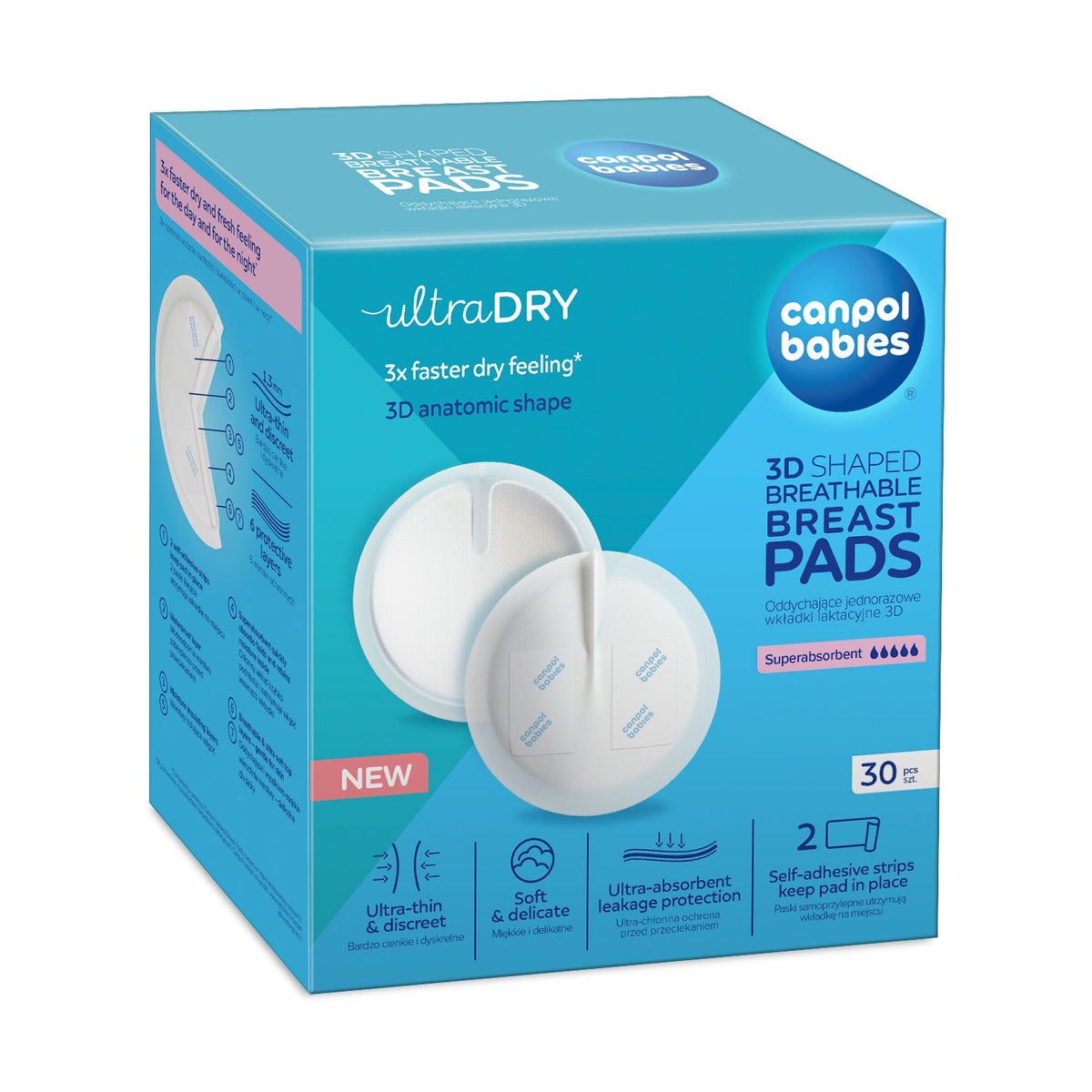
Canpol babies 3D anatomically shaped breast pads have, according to the manufacturer, 6 layers, are 1.3 mm thin, have two adhesive strips and are individually wrapped. LOVI Discreet Elegance breast pads are, according to the manufacturer, 1 mm thin, absorb up to 100 ml and are also individually wrapped. Browse more in Breast pads.
Nipple lanolin
Canpol babies lanolin cream (7 g stick) and LOVI lanolin cream (37 g) contain, according to the manufacturers, 100% pure lanolin with no additives, so there is no need to wash it off before feeding. More in Breast care.
Nursing pillow
A pillow helps raise your baby to breast height and takes strain off your arms and back. The KikkaBoo Hedge-hugs nursing pillow measures 60 × 47 × 20 cm according to the manufacturer, has a removable zipped cover and OEKO-TEX certified materials. Use it while feeding; for sleep, your baby should lie on their back on a flat, firm surface with no pillows. See all models in Nursing pillows.
Breast pump – only when you need one
If your baby is feeding well, you usually don't need a pump in the first weeks. It helps if you're separated from your baby, your baby has trouble sucking, or a lactation consultant recommends it. For occasional expressing, the Canpol babies Basic Light manual breast pump works without electricity, is quiet and fits Canpol babies bottles, according to the manufacturer. See our guide How to choose a breast pump and all models in Breast pumps.
Full range: Breastfeeding, Canpol babies and LOVI.
Frequently asked questions
How many times a day should I breastfeed a newborn?
Usually at least 8 to 12 times in 24 hours, including at night (NHS). Feed on hunger cues, not by the clock.
How long should a feed last?
There's no fixed rule; UNICEF UK gives roughly 5 to 40 minutes. Let your baby come off the breast on their own, then offer the other side.
Should I wake a sleepy baby for feeds?
In the first days and weeks, if your baby is very sleepy and feeding fewer than 8 times a day, gently encourage feeds with skin-to-skin and by offering the breast in light sleep. If there are fewer than 6 feeds in 24 hours, speak to your midwife or doctor.
Does a breastfed baby need water?
No. WHO recommends exclusive breastfeeding for the first 6 months, with no water, tea or other drinks.
How do I know I have enough milk if I can't see how much my baby drinks?
Count nappies (see the table), listen for swallowing and follow weight checks. If the signs aren't in range, ask for help early.
Is it normal for my baby to feed almost constantly for a few days?
Yes, cluster feeding is common, especially in the first weeks. If your baby has enough nappies and is gaining weight, it's usually normal.
Sources
- NHS – Breastfeeding: the first few days
- NHS – Breastfeeding: positioning and attachment
- NHS – Breastfeeding: is my baby getting enough milk?
- NHS – Newborn jaundice
- UNICEF UK Baby Friendly Initiative – How can I tell that breastfeeding is going well?
- WHO – Infant and young child feeding
- NICE – Faltering growth (QS197)
- La Leche League GB – Beginning breastfeeding
This content is for information only and does not replace advice from your baby's doctor. For breastfeeding difficulties, contact your midwife or a lactation consultant (IBCLC).


